Hardware notebook.
The first rig
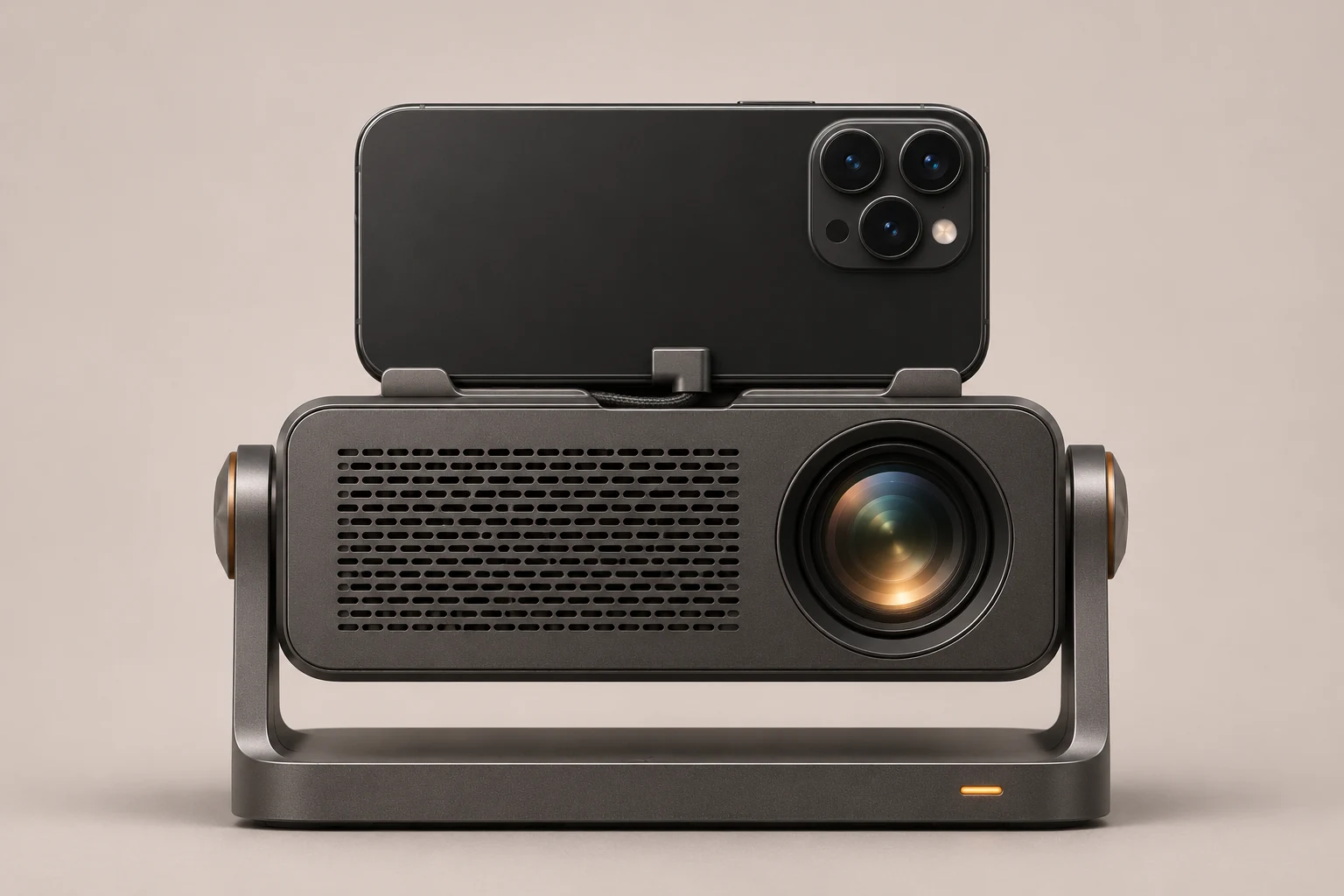
Use a wall-powered XGIMI Elfin Flip Laser with a removable iPhone cradle. Its 150° stand can aim at the wall and ceiling. At a distance of 8 feet, its 1.2:1 lens covers about 6 feet 8 inches of a flat wall. XGIMI lists the 1080p model at $549 and rates it at 1,600 ISO lumens in high-power laboratory conditions. Measure brightness and fan noise together in the mode guests would actually use. Projector specifications · US pricing
The iPhone 17 Pro Max measures 163.4 × 78.0 × 8.75 mm and has a rear 120° ultrawide camera. Measure the actual camera bump, cable bend and case clearance before cutting the cradle. Give the phone repeatable seating stops and keep the projector vents clear through the full tilt. Center the 0.5× camera directly above the projector aperture. The two optical centers still sit a short distance apart. Measure that separation on the bench, calibrate at the working distance, and check the illuminated edge of a ledge after each re-dock. A button at the base can start a round when the screen is facing away. Apple hardware specifications
An 11-inch iPad Pro (fourth generation) also has a rear ultrawide camera. Its larger screen offers little advantage once the unit tilts away from the table. Start with one iPhone cradle and use Apple’s mechanical drawing to check the camera and cable clearances. iPad camera specifications · iPhone mechanical drawing
What runs where
Start with Swift for the app, AVFoundation for camera and audio, and Metal for drawing the corrected image. Send video over a powered USB-C display adapter. Keep control and setup on the phone, and send only patterns and artwork to the projector. Once the rig settles, scan and reuse the map. Benchmark capture time, frame rate and temperature over a full session before sizing an onboard processor. Apple external-display guidance
Optical engines to sample
These are published industrial base designs from two Shenzhen manufacturers. Prices, supply and engineering support need written quotations. Each brightness figure retains its supplier’s measurement label.
Decisions before tooling
- Coverage and legibility. At two distances, record projected width, ambient lux at the wall, and the part of the lit area the camera can decode. Read lyrics from the opposite seat. Compare a stock short-throw lens before paying for custom optics.
- Dock or dedicated compute. Repeat the scan after five re-docks and after tilting the unit. Run a full game while charging. Ask hosts whether they would leave their phone in the cradle through dinner. Take that result and measured compute load into the standalone pricing discussion.
- Pilot or production. Assemble a proposed 25–50-unit pilot using production-intent parts. Record first-pass yield, optical alignment time, packed transit damage, surface temperatures and support calls. Set the order size after reviewing landed cost, delivery lead time and pilot results.
What the supplier quote should cover
Ask for one to three samples, current availability and lead time, optical drawings and mechanical CAD, stock lens alternatives, driver board and video inputs, pattern timing and image-processing bypass. Request continuous-run power, cooling limits and noise measurements.
Price the same build at 100, 500 and 2,000 units. Separate sample fees, custom lens engineering, tooling, factory alignment fixtures and final assembly. Confirm the minimum order, tooling ownership, yield assumptions, freight terms, warranty, and which test reports apply to the finished configuration. These are evaluation quantities, subject to quotation.